
 +44 (0)1905 794875
 Wholesale Prices

Road Sign Reflectivity: How Do Reflective Signs Work?
We all take for granted the easy visibility of road signs as we drive after hours or on dark, gloomy winter days. If you were to go back in time, you would quickly realise how many modern innovations make modern road signs massively more visible than their outdated vintage counterparts.
Within this article, we will look at the following points:
Why are road signs made from reflective materials?
How do retro-reflective signs work?
How are reflective signs made?
What makes road signs reflective?
How to choose the right grade for a reflective sign?
This will help us understand how to choose the right grade of reflective material for road signs, allowing you to make an informed decision and get the best results from your permanent or temporary reflective road signage.
With the myriad of choices available and industry terms for the reflectivity grade, it is easy to get lost in the jargon - which this article will help to clear up.

Why are road signs made from reflective materials?
All road signs in the UK must have retro-reflective surfaces so that drivers can see them in all light conditions. But apart from the legislation, road signs need to be reflective for practical purposes.
Reflective signs, specifically retro-reflective ones, make them far more visible to vehicle drivers. They give advance notice of hazards, restrictions, regulations, and directions, improving road safety as drivers have more time to react and adjust to posted changes in road conditions or information.
Retro-reflective signage takes any light that hits the sign (from vehicle headlights) and bounces it back to the source, allowing the sign to show up brightly and clearly against an otherwise dimly-lit background.
If you're a driver, you will almost certainly have noticed that road signs seem to “light up” when your headlights hit them, even compared to otherwise light and reflective surrounding surfaces.
This is also beneficial because the sign doesn’t require independent illumination from a fixed light source, which saves power and reduces light pollution.
(NOTE: some types of road sign may require illumination - see Part 1 Regulation 8 of the The Traffic Signs Regulations and General Directions 2016.)
How do retro-reflective signs work?
So, we understand why reflectivity is necessary, but how do road signs reflect light? And what’s the difference between reflective and retro-reflective materials?
Let’s take a mirror as an example of a reflective (but not retro-reflective) surface. If you shine a torch at a mirror at a 45-degree angle, the light will simply bounce off the mirror and shine onto a nearby object. Almost none of the light will be returned to the source, and the mirror will appear no brighter to you.
In the same test, a retro-reflective surface will take the light from the torch and send a very high proportion of it back directly to the source. In return, you will see the surface light up almost as if it were self-illuminating.
How are reflective signs made?
Modern-day road signs are made from various materials. The most common composition is a composite backing (substrate) with a retro-reflective face and sometimes an optional overlay to protect against graffiti or other contaminants.
The substrate provides a flat surface that's structurally strong enough to support the face material. It will normally incorporate some mounting hardware, allowing the sign to be attached to a post, wall, gantry, or similar support.
The face material is made from retro-reflective sheeting. Various colours are available, but it is supplied on large blank white/silver rolls for most traffic applications. These are then printed using specialist inks that allow colours to stand out vibrantly, while also hardening them to the detrimental effects of the sun's UV rays.
During manufacturing, the sign’s face is printed, and then each face is “rolled” onto the substrate. It's similar to how you would apply a phone screen protector but at a much larger scale.

What makes road signs reflective?
Road signs are made reflective by the retro-reflective films used to face the signs. Stepping back in time, signs were made reflective by using items such as glass marbles (similar to cat's eyes) to highlight wording and features.
These large cat's eyes were eventually replaced by thousands of tiny glass beads bonded into a sheet, each one acting like a larger cat's eye to bounce light back at the source. However, this material struggles to perform where street lighting is present, as the amount of light returned to the source is often not enough to make the sign stand out in car headlights.
Most road-grade retro-reflective materials now use specially-formed plastic films with an adhesive backing, to emulate and improve upon the performance of glass beads. These films are far more reliable, resistant to wear and tear, and outperform alternatives by a large margin.
How to choose the right grade for a reflective sign?
There are many types of reflective materials and their properties can differ greatly. So, which grade do you need for your installation? This will depend on the application - for instance, if you’re dealing with speed limit signs, RA2 is the standard.
For simplicity's sake, we have narrowed this list down to common types that are predominantly used in the UK and omitted some of the fringe and lesser-used products.
- RA1 (also known as R1 & AEGP or Advanced Engineering Grade Prismatic): Returning 16% of light to its source, this grade is most commonly used for signs that are not critical for drivers, such as those targeted at pedestrians and cyclists. Example applications include parking restriction signs, cycle route signs, street names, and temporary signage.
- R2 / RA2 (also known as HIP or High Intensity Prismatic): Ramping up the performance, these signs return 32% of light to its source or the driver. This is the most common reflectivity grade for signs on the UK road network, representing most standard general road signage.
- R3B: This grade of material returns 58% of light to the driver. It is used where lighting is critical or the sign is “disadvantaged”. A disadvantaged sign might be one that’s competing with other light sources (such as brightly-lit shop fronts), mounted to the right-hand side of the road, angled heavily away from the roadway, or mounted exceptionally high.
- R3C: This material has similar performance characteristics to the R3B material, but it’s targeted more towards HGVs and similar vehicles where the headlight source is further away from the cab. It is very commonly used for HGV-specific signage, such as height restrictions and directions for HGV traffic specifically - including within HGV parking areas at services.

Closing thoughts
We hope this article has broadened your understanding of the different types of road sign reflective grades, how they work, and why they exist. If you have any questions, please do not hesitate to get in touch with our team.
Alternatively, you can browse our range of road signs, both permanent and temporary, in our store. This includes custom reflective road signs to suit your needs.
FAQs
Does acetone damage reflective foil on road signs?
It’s important to keep road signs clean so that they remain fully visible to road users. But with retro-reflective road signs, you must take care not to damage the film. Avoid abrasive substances like acetone, and don’t scrub or use high-pressure sprayers. Use a soft cloth and a gentle cleaner with a pH of 6 to 8, such as diluted isopropyl alcohol.
Where else is retro-reflective material used?
Emergency vehicles must have retroreflective markings that make them easily visible to other road users. This is also the case for vehicles that stop or are used for work purposes on highways.
The UK and European regulation ECE 104 mandates that HGVs and trailers must use retroreflective markings, such as conspicuity tape. There are rules about colour and positioning - find more information here.
You can also add retro-reflective tape to barriers, gates, fence posts, workwear, or anything else that needs to be visible in low light.
- Author
- Tags

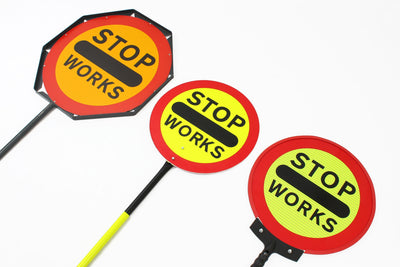


You might like:
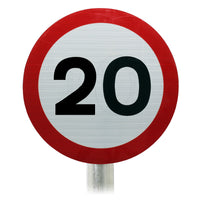
20mph Speed Limit Sign, Post Mounted Diagram 670 R2/RA2
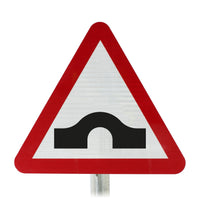
Hump Bridge Ahead Sign Post Mounted - Dia 528 R2/RA2 (Face Only)

STOP Sign, Post Mounted Diagram 601.1 R2/RA2
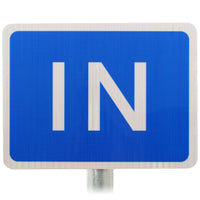
IN Sign DIA 833 Post Mounted Various Sizes R2/RA2
Disabled Badge Holders Only Sign Post Mounted Dia. 661A R2/RA2
Wild Fowl Likely in Road Ahead Post Mounted Sign - 551.2 R2/RA2 (Face Only)

