+44 (0)1905 794875
 Wholesale Prices

Hearing Protection: Why It Matters In Your Workplace
In many workplaces, the tools and equipment you use can generate potentially damaging levels of noise. And this isn’t limited to industries like construction or quarrying - even working at noisy events can affect your hearing.
It’s vital to protect your workforce against hearing damage, but how do you know which hearing protection solution is best for your needs?
In this article, we’ll explain why hearing protection is so important, the differences between the various types, and how to choose the appropriate level of protection for your workplace.
In a hurry? Use the quick links below to skip to the section you need.
Why is hearing protection important?
Where is hearing protection used?
What level of noise requires hearing protection?
Why is hearing protection important?
Hearing damage can occur from a one-off exposure to a loud event, exposure to louder-than-average environments over a period of years, or even exceptionally loud noises as a one-off incident. You may experience symptoms including:
-
Muffled hearing: where everything sounds dull and detail is lost
-
Tinnitus: where you hear a constant whistling noise above everything else
-
Complete deafness: where you can no longer hear a phone ring or listen to your favourite music.
These effects can be instantaneous or they may only appear much later in life. To have the best chance of preventing permanent damage to your hearing, you must protect your ears with hearing-related PPE wherever possible.

Where is hearing protection used?
Hearing protection is a requirement in many industries and environments. For example:
Construction
Workers who use power tools such as saws and drills over many years can experience hearing problems later in life.
Demolition
Explosives and sledgehammers can both generate uncomfortable noise levels.
Manufacturing
Milling machinery and other processing equipment can expose operators to unsafe sound levels.
Airports
A jet engine is often used as the benchmark for a very loud event. Employees working on the tarmac apron, therefore, require high levels of protection.

Sporting events
Large crowds can collectively produce levels of noise that can damage the hearing of staff members who are exposed to it frequently.
Music venues & festivals
Security staff who attend many concerts will need to wear hearing protection to prevent long-term hearing damage.
Marine
When working in the engine room of a large ship, workers often carry out maintenance while loud equipment, such as pumps and air ventilators, is running.
Mining & quarrying
Equipment operators work with the constant hum of a diesel engine right behind them. They are also exposed to other equipment, such as drills, that causes excessive noise.
Types of hearing protection
Several types of ear protection PPE are available, each with its own benefits and drawbacks. We stock all types, allowing you to make an informed choice when choosing your hearing protection.
Disposable ear plugs
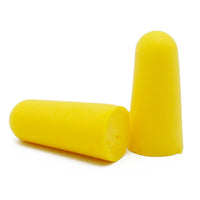
Disposable ear plugs are usually single-use items, made from foam rubber or a similar material. You squash them between your fingers and insert them into the ear canal, where they expand to block out sound for effective hearing protection.
Pros and cons of disposable ear plugs
✅ More affordable than ear defenders
✅ No interference with other PPE
✅ Extremely effective if worn correctly
❌ Can be uncomfortable for some users
❌ Can irritate the ear canal if worn frequently
❌ Not as environmentally-friendly as other solutions
❌ If they fall out, they are easily lost
❌ Can be hard to ensure they are “fitted” properly, allowing sound to leak around the plug
❌ Risk of ear infection if you don’t have clean hands when inserting them.

Reusable ear plugs
Reusable plugs fit into the ear canal like disposable plugs to block excessive noise. They often come corded together or on a band, and you can wash some variants to keep them clean.
Pros and cons of reusable ear plugs
✅ More affordable than ear defenders
✅ No interference with other PPE
❌ Can be uncomfortable for some users
❌ Can irritate the ear canal if worn frequently
❌ Often disposed of similarly to disposable plugs
❌ Risk of ear infection if they are not kept clean.

Ear defenders
These hearing protectors sit over the ears and are available in various sizes and ratings to suit the level of protection required. They are not considered disposable, and higher-quality units can be self-serviced to renew them. Standard versions are sometimes called “passive” ear defenders, and they block out all sound.
Pros and cons of ear defenders
✅ Cover the entirety of the ear, helping to keep you warm
✅ Still relatively affordable to purchase
✅ Helmet-mounted variants available for use with hard hats
✅ Can be self-serviced to renew them
❌ Other PPE, such as glasses or safety specs, can interfere with the airtight seal around the ear, impacting performance.
❌ Long hair and hats can also affect their efficacy.

Active listening ear defenders
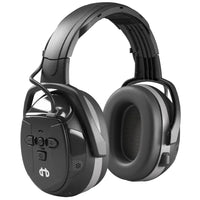
Active listening models have the same format as standard over-ear defenders, but they feature external microphones and internal speakers so you can hear important sounds - such as instructions and alerts - at a safe volume. Excessive noise is not reproduced inside the headset and is blocked by the ear defenders.
Pros and cons of active listening ear defenders
✅ All the benefits of standard over-ear defenders
✅ You can still hear colleagues talking and listen for potential hazards
❌ More expensive than standard ear defenders
❌ Batteries need replacing or charging
❌ Heavier weight than standard ear defenders.

Communication headsets
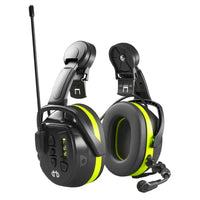
Communication ear defenders come complete with an integrated radio communication system. This allows workers to communicate over long distances, individually or as a team, while also protecting against excessive noise.
Pros and cons of communication ear defenders
✅ All the benefits of active ear defenders
✅ Ability to communicate with other workers at a distance or in a vehicle
✅ Can be self-serviced to renew them
❌ Much more expensive than other solutions
❌ Heavier than standard ear defenders
❌ Batteries need charging or replacing.
What level of noise requires hearing protection?
It’s not just a case of setting a “safe” level of decibels and mandating hearing protection for any environment where noise exceeds that level. Hearing damage can be cumulative, and even a relatively quiet environment can cause hearing damage after long-term exposure.
Sudden and abrupt loud noise, like an explosion or steel sheeting being stamped, would require hearing protection even in an otherwise quiet environment.
There’s also a quick way to determine whether or not hearing protection PPE should be considered in your role or site. Ask yourself these questions:
-
Is there intrusive noise - a constant sound such as a vacuum cleaner, a crowded echoing restaurant, or a busy street?
-
Do you have to raise your voice to speak to someone who is 2m away from you?
-
Do you use any power tools that make noise, such as hammer drills, electric saws, or grinders?
-
Do you work around machinery that makes a constant noise, such as large fan units, milling machines, forging or stamping machines?
-
Are there any loud noises caused by hammering or concussive impacts, such as drop forging, pneumatic tools, blasting, stamping, or piling?
-
Do you ever finish a work shift and feel that your hearing is muffled or not as sharp as usual?
If the answer to any of these questions is yes, you should immediately find out what noise control measures are in place and ensure there is adequate protection where needed.
The HSE website also has excellent resources for calculating noise exposure.

What SNR rating do I need?
You will see that many hearing protection devices are marked with “SNR” and a number. SNR stands for Single Number Rating, and it’s part of the EN 352 series of standards for hearing protectors across Europe.
The number represents the average noise reduction provided by your ear defenders or plugs, shown in decibels (dB). For example, a headset with a rating of SNR 30 can reduce 115 dB of noise by 30 decibels.
Higher SNRs indicate greater noise reduction - but higher isn’t necessarily better in every situation. That’s because it is actually possible to over-protect: if your hearing protection reduces noise levels to below 70dB, you won’t be able to hear danger warnings.
Ideally, you want to reduce the noise levels you’re exposed to down to at least 85dB. But it’s important to calculate the appropriate levels for your workplace. You can do that on the HSE website.
Alongside the SNR, you might see the letter H, M, or L on European hearing protectors. These values relate to attenuation performance for different pitch ranges of sound, showing how the device handles high-, medium-, and low-frequency noise.
Final thoughts
Exposure to loud noise in the workplace can cause serious damage, from tinnitus to permanent hearing loss. Don’t wait until it’s too late - make sure you and your team are wearing the right hearing protection.
You can find a vast range of over-ear and in-ear solutions, plus useful accessories, at Start Safety. If you’re still unsure about which products to choose, give us a call for friendly advice!
FAQs
What type of hearing protection is best?
This depends entirely on the job type and the working environment. Follow the guidance from the HSE to find the appropriate level of protection, and look at our checklist of the pros and cons for various types of hearing protector.
Is hearing protection a legal requirement?
The Control of Noise at Work Regulations 2005 sets out specific levels of noise exposure above which employers must provide hearing protection:
-
85 dB(A) or above (daily or weekly average exposure) - employers must provide hearing protection and hearing protection zones
-
80 dB(A) or above - employers must assess the risk to workers' health and provide information and training
-
87 dB(A) - exposure limit value above which workers must not be exposed, taking account of any reduction provided by hearing protection.
How can I protect my hearing at work?
Employers must provide suitable hearing protection that aligns with noise levels in the specific workplace. As an employee, you should make sure you know how to wear and use the protective equipment correctly, and raise any hearing-related problems with your manager.
- Author
Related articles

You might like:
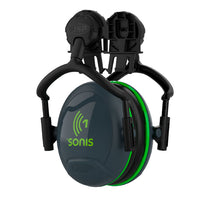
JSP Sonis 1 Helmet Mounted Ear Defenders Grey/Green Plate - SNR 26 | AEB012-1CY-800
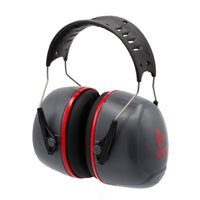
JSP Sonis 3 Ear Defenders Head Band Grey/Red -SNR 37 | AEB040-0A1-A00
JSP Sonis 3 Hygiene Kit | AEB830-000-600
JSP Soundstopper - PU Foam Ear Plugs

Hellberg Active Headband Style Active Listening Ear Defenders - SNR 30 | 47002-001 (by Snickers)
Hellberg Local 446 Helmet Mounted Group Comms & Radio Active Listening Ear Defenders - SNR 30 | 85101-001 (by Snickers)
Hellberg XstreamLD Headband Style Comms & Bluetooth Active Listening Ear Defenders - SNR 29 | 48001-001 (by Snickers)
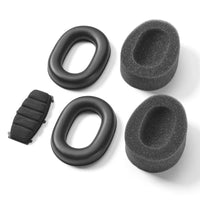
Hygiene Kits for Hellberg Passive Ear Defenders (by Snickers)