+44 (0)1905 794875
 Wholesale Prices

Parking Bay Marking Regulations
Marking out parking bays for car parks or on-street parking may seem like a matter of common sense - you need clearly-defined spaces, visible lines, and accessible parking areas.
But what are the official parking bay marking regulations, and are there some aspects that are often overlooked?
In this article, we’ll give you the lowdown on creating compliant, safe, and user-friendly parking.

The importance of clear parking bays
By following regulations and guidelines, you can create sensible layouts for car parks and on-street parking areas - ensuring that there are designated spaces for various types of driver, and that vehicles can park safely.
When parking bays are clearly and correctly marked out, drivers can quickly find the appropriate place to park. This avoids confusion and traffic bottlenecks, and can even guard against road rage incidents caused by inconsiderate parking.
(Yes, there will always be a few people who think it’s OK to park illegally, but at least if the markings are clear, you can enforce the rules.)
It’s also worth knowing the standards so you can mark out parking bays of the right size and in the optimum location. Otherwise, drivers will damage other vehicles when opening their doors or driving through tight gaps. With cars increasing in size, this is becoming more of a problem.
The impact of vehicle size
According to research by campaign group Transport & Environment (T&E) and Clean Cities, our cars are getting steadily bigger. Vehicle width has increased by an average of 0.5 cm per year since 2000, while the average length of new cars is growing by 1.2 cm a year.
We’ll take the Mini as an example: the 2026 Mini Cooper (electric version) is a massive 346 mm wider than the 1959 Classic Mini. That’s an increase of almost 25%. And it’s not just cars - a 2023 study by Vanarama revealed that 8 of the 10 most popular vans in the UK were too long for the average parking space.

If this trend continues, T&E calculates that cities will lose up to 14% of their end-to-end on-street parking spaces by 2040. And many car parking bays - which were designed when vehicles were much smaller - are now inadequate.
Some parking providers are changing their layouts to address this, such as NCP, who widened the bays in some of their car parks back in 2016. But the trade-off is that bigger bays mean fewer overall parking spaces.
Types of parking bay
Depending on the dimensions of the car park or roadside parking zone, you might use the following arrangements for parking bays:
-
Perpendicular (vehicles parked side by side at 90 degrees to the aisle or kerb)
-
Echelon (angled/diagonal/slanted bays at an acute angle to the road or aisle)
-
Parallel (vehicles in a line along the roadside)
Specific types of car parking bay include disabled parking, parent/child spaces (both of which are wider to accommodate wheelchairs and pushchairs), EV charging bays, and spaces designated for taxis or unloading vehicles.
In parking zones designed to accommodate large vans, lorries, or coaches, the bays will obviously need to be much bigger. You should also include dedicated spaces for motorbikes and bicycles.

What regulations apply to parking bay markings?
Let’s find out if there are any specific rules you need to follow when creating or updating parking bay markings.
Off-street parking
For private and public car parks, there are no official regulations for parking bays - just guidance to help you make them safe and user-friendly. However, it’s always best to check with your local planning authority as they may have their own standards. We’ll provide some examples of guidance from local councils at the end of this article.
Disabled spaces
The Equality Act 2010 states that public service providers must make adjustments wherever disabled people experience a “substantial disadvantage”. According to guidance from the Department for Transport, provision should be made for designated spaces for disabled motorists and passengers (Blue Badge holders) wherever parking is provided.
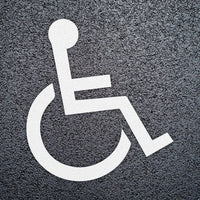
Disabled parking areas should be located as close as possible to the main entrance of the premises or destination (ideally within 50 metres). They should be on level ground with any variation of surface profile not exceeding ± 5m, and include clear signage with the international symbol.
Size and layout of parking bays
Again, there are no rules for size and layout in off-street car parks. Many older car parks still use the dimensions originally recommended by the Institution of Structural Engineers (IStructE), with standard parking bays 4.8m long and 2.4m wide. As we mentioned earlier, this is no longer wide enough for some of today’s cars.
With that in mind, IStructE renewed its design guidance for multi-storey car parks (recommending bays 5 m long and 2.6 m wide) but no new guidance exists for other types of car park.
In the absence of a hard and fast rule, our advice is to make sure that standard bays are at least 2.4m wide, but consider making them wider.
For disabled parking, the DfT Inclusive mobility guide suggests that bays are a minimum of 4.8 m long and 2.4 m wide. If the bays are perpendicular to the access aisle, you should include an extra width of 1.2 m on each side (this can be shared with adjacent spaces). An additional zone of 1.2 m at the vehicle access end of the space will enable rear access and deployment of rear hoists.
If the accessible space is parallel to the access aisle, include an additional zone of at least 1.8 m to enable access from the side.

Bays for large vehicles
The maximum width for lorries in the UK is 2.55 metres, while length varies from 12 m to 18.75 m (exceptions may apply for abnormal loads). There are no regulations for parking bay size, but many local councils recommend lorry bays between 3.5 m and 5m wide.
The average 60-seater coach measures 2.55 m x 12 m. If your car park needs to accommodate coaches, the British Parking Association recommends parking bays of at least 5 m wide and 15 m long.
Larger vans also need larger bays, typically for their length rather than width. For a Ford Transit, even the medium wheelbase version is 5.53 m long, which would overhang a traditional parking bay by quite some way.
Number of bays
There are no set rules for the overall number of bays in an off-street car park.
However, for disabled parking, the DfT gives recommendations for the proportion of designated bays to include. This depends on the type of car park and the total capacity, but the figure ranges from 2% to 6% of the total spaces.
For example, if the car park is for a retirement home or a hospital, you would need to include a higher number of disabled spaces. See the DfT Inclusive mobility guide for a full breakdown.

Colour of markings
In public and private off-street car parks, you don’t have to stick to a fixed colour scheme for bay markings. However, in most car parks you’ll see the same colours as those used for parking bays on the street, which we’ll cover in the next section.
White is typically used for standard parking bay lines and general markings, with yellow for restrictions and loading bays. Off-street parking may also use blue for disabled parking bays and symbols, and green to denote EV charging bays.
Pedestrian walkways within car parks may also be coloured to make them stand out.
On-street parking
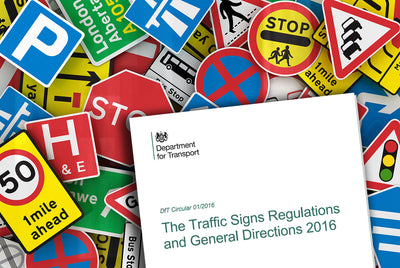
Parking bays on public carriageways are governed by the Traffic Signs Regulations and General Directions (TSRGD) 2016 (Chapter 3, section 13.6, from page 156). This includes on-street parking spaces reserved for Blue Badge holders. A standard parking bay is prescribed as diagram 1028.4.

Size and placement of bays
The 2016 version of TSRGD relaxed the previous rules on dimensions for most on-street parking bays, removing maximum widths and lengths. This means that bays can be designed to accommodate various sizes of vehicle where necessary.
Individual spaces parallel to the carriageway require a minimum width of 1.8 and a minimum length of 4.5 m. For echelon parking, each bay requires a minimum length of 4.2 m and minimum width of 2 m.
The exceptions are for on-street parking bays reserved for Blue Badge holders, which must be at least 6.6 m long. The width of these bays must be at least 2.7 m (or at least 3 m if placed in the centre of the carriageway), except in cases where, due to the nature of traffic using the road, the carriageway’s overall width is not enough to accommodate a bay of the prescribed width. For echelon layouts, disabled spaces must be at least 3.6 m wide.
If the bay is laid adjacent to the road edge, it should be designed so that neither it nor any associated “legend” (on-road wording that explains what the bay is for) overlaps the centre line road marking.
Width of lines
The standard width of the painted or thermoplastic lines that outline parking bays is 50 mm. If you need to give greater emphasis (or to reduce maintenance) you can use 75 mm lines.
For a block-paved surface where you’re painting blocks to form the outlines of the bays, the lines may be as wide as 100mm. It’s best to use acrylic line marking paint to colour the blocks, as not all thermoplastic tape works on block paving.

Colour of markings
The TSRGD states that on-street parking bays must stand out from the surrounding parts of the road and any adjoining bays, so that drivers can clearly see where to park.
There are three standard colours allowed for on-road markings: white, yellow, and red. These must conform to the chromaticity requirements in BS EN 1436. This includes parking bays, which use the following colours:
-
White: standard parking bay lines and general markings
-
Yellow: No-parking areas, loading bays, and restrictions (for example, a parking bay solely for taxis)
-
Red: On urban red routes where a parking or loading bay is available for a specified class of user during part of the period of operation of a red route with no stopping at other times, or where the bay operates only outside the period of operation.
Traffic authorities can also create bays and spaces on the carriageway with colour-contrasting surfacing, or paving in a different pattern or appearance, to distinguish parking areas from the surrounding carriageway.
Wording
Depending on the use of the bay, you may want to include a “legend” as well as an outline. For example, “DISABLED” or “LOADING BAY”. This must be marked outside of the bay so that it can be read by passing drivers and not obscured by parked vehicles.
The letter height may be any size between 350 mm and 700 mm, with larger sizes appropriate for wide or fast roads.
Pavement parking
Outside of London, traffic authorities can put official marked parking bays on or partially on a footway. As part of diagram 1028.4, there are two prescribed patterns for these - pattern (b) for bays situated partially on the footway, and pattern (a) for a bay wholly on the footway. Where the bay is wholly on the footway, it must be adjacent to the kerb. Signage would typically accompany this type of bay.

Other aspects to consider
Here are a few more considerations for marking out parking bays.
Marking materials
There are various materials available for marking out parking bays, and your choice will depend on factors like traffic volume and ease of application.
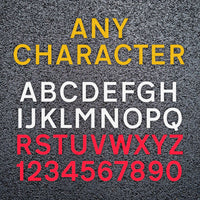
Thermoplastic markings come as preformed rolls, strips, or sheets and pre-cut symbols, letters, and numbers, which are melted onto the surface with a gas torch. They make it easy to create uniform parking bay lines and to denote the type of bay.
Thermoplastics are highly durable, and won’t spread under heavy traffic or in hot weather. However, they can be difficult to apply to some surface dressings and are not recommended for block paving.

Painted lines take a little more effort to apply, and can wear away more quickly under heavy traffic. This is less of a problem for car park markings than for on-street bays. The advantage of line marking paint is that it’s thinner than thermoplastic material, so it won’t interfere with drainage on the road. It’s also ideal for creating large areas of colour.
The TSRGD states that road marking materials for carriageways may be thermoplastic, cold plastic, preformed material, or paint. You can use any of these for on-street parking bays, but make sure your chosen material conforms to European and British standards (specified in Chapter 5, section 12.3, page 116). Off-street car parks are not bound by TSRGD.
Signage
Depending on the type of parking bay, you may need to include some post- or wall-mounted signage. For example, signs can explain that the bays have time limits or other restrictions.
Disability parking signage should be placed at the head of the designated bays, so that people can still understand the purpose of the bays even if the surface markings are faded or obscured.
It’s also helpful to install directional signs to help people find specific parking bays.

Maintenance
It’s essential to keep parking bay markings in good condition - if they are worn or faded, drivers may be confused about where to park (or they may try to get away with bad parking, and it will be almost impossible to enforce a fine).
Unclear markings can also lead to accessibility problems, and to lack of compliance with on-street parking regulations.
You should clean car park line markings (and signage) regularly, and carry out frequent checks so you can spot problems and make any necessary repairs. It’s also wise to check for any changes to relevant regulations.
Closing thoughts
Parking bay marking regulations do exist for on-road parking, and you’ll need to follow these to stay compliant. You have more leeway with off-street car parks, but it’s best to follow the guidelines, especially for accessible parking.
Ready to buy thermoplastic markings and paints to mark out parking bays? Find what you need in our online shop, or chat to our friendly sales team for extra advice.
Local authority guidelines
If you’re still unsure about parking bay sizes or layout, it’s worth taking a look at guidance from local authorities. Here are some examples.
- Author
Related articles




You might like:
Preformed Thermoplastic Numbers & Letters - Road Markings

StartMark Thermoplastic Road Line Marking Paint 5m Roll Pre-Beaded, White (RAL 9003)

ST Thermoplastic Primer HiTack Clear - 750ml

Glass Beads for Thermoplastic Road Markings - Per kg

Heavy Duty Line Marking Paint - Chlorinated Rubber Alternative 6kg & 25kg
Clear Primer for Thermoplastic Marking & Line Marking Paint

StartMark Thermoplastic Road Line Marking Paint Roll Pre-Beaded, Yellow (RAL 1003)
Disabled Road Sign For Parking Bays Thermoplastic
Thermoplastic Zebra Crossing Panels (1m x 500mm)
Path / Walking Man Symbol - Car Park Road Markings
PROline Spray Paint Line Marking Paint 750ml Aerosol